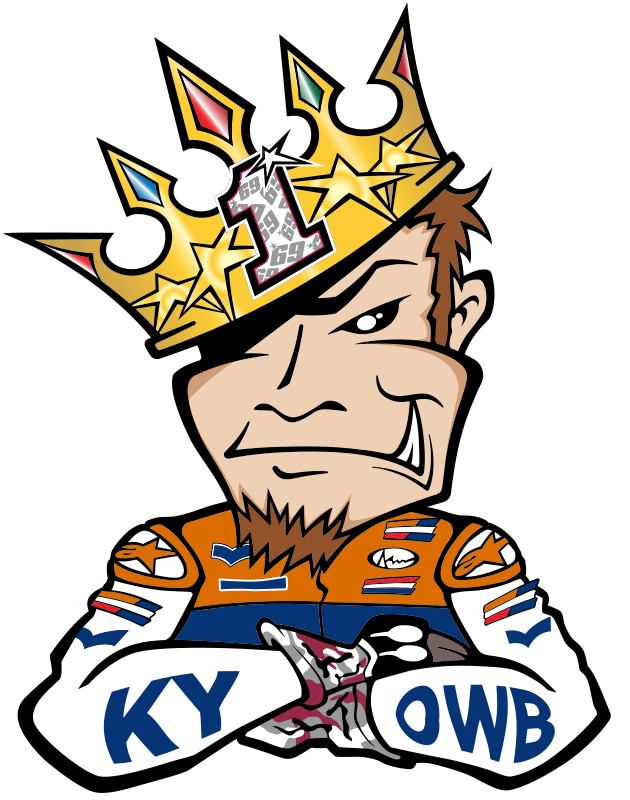
Menace
to Society or Just a Motorcycle Racer?
by dean adams (1998)
"How old's your boy?" asked Anthony
Gobert, the famed former Lucky Strike Suzuki rider and current Vance and
Hines Ducati star pilot, as he and I sat against the pit wall at Daytona
last December at the Dunlop test.
We were watching my son John play
vigorously with a toy truck in a scrap of dirt he'd found.
He's four years old, I told him.
Gobert watched the lad for a few minutes and then asked how many children
I have. In response, I rolled my eyes and told him just one, and based
on this one, it'll be some time before I have another. Kids, as you parents
out there are aware, can be a handful.
Gobert smiled and said, "Yeah, my
parents said they had to wait five years before they had my little brothers."
He stopped for a moment and said, "I think I was kind of rough on them."
It doesn't take much imagination
to conjure up images and situations of a pre-adolescent Anthony that might
have been just a tad bit trying for his parents.
While the post-adolescent Gobert
might now sound understanding of his parents' plight, based on press reports,
he probably still gives them plenty of cause for consternation. A turbulent
young man, he likes to party and to live like he rides--on the edge. Whether
it's a day of motocrossing with his pals in Australia, or teasing the strippers
at the Pink Pony in Daytona Beach, the kid likes to have fun and he doesn't
really care who knows it, even if it means Mick Doohan gets offended. (As
you might recall, Gobert referred to Doohan as "the Queen Bee" last year
when the two had a slight altercation.) Gobert's renown throughout the
GP world didn't end with pissing off fellow riders. He'd had a makeshift
hot tub installed in his motorhome and his post-race parties were memorable,
so I've been told.
Somebody needed to warn the boy before
he found himself jobless last year. In the current Grand Prix climate,
too much fun will shorten a rider's career faster than getting a right
thumb ground off in a crash. Accepted behavior now is to smile for the
cameras, thank your sponsors, sign some autographs and get back to the
hotel as fast as humanly possible without ruffling any feathers. Young
Gobert was ushered into GP with Garry Taylor and the whole Lucky Strike
armada predicting he'd be the next Kevin Schwantz. Only they forgot to
tell Gobi that they wanted someone who could ride like Kevin Schwantz but
who acted like the squeaky clean Freddie Spencer, a devout Christian from
the start who didn't need to be born again like so many riders.
How times have changed for guys who
make their living competing on a motorcycle. 20 years ago upstanding citizens
of this country would have pursed their lips and vilified Anthony with
two little words: "motorcycle racer." The occupational title "Motorcycle
Racer" was a direct synonym for "Hell-Raiser" and everyone knew it. In
that era racers were not known for their volunteer work with the poor,
for being deacons of the church, or for their politically correct viewpoints.
Rather, they were known for tearing around on motorcycles, for being drunk
two hours after the checkered flag flew, for ripping doors off of hotel
rooms and for starting massive food fights and things of that nature. All
one had to say about another man was that he was a "motorcycle racer".
No further description was required, and no, he wasn't invited to Sunday
dinner.
All that has changed. Thanks to efforts
by the American Motorcyclist Association and American Honda, the reputation
of normal street-riding motorcyclists in this country has improved so vastly
within the past twenty years that, should you ride your motorcycle to work
everyday, you won't be immediately ostracized. For the most part, motorcyclists
today are recognized as fairly normal and upstanding citizens of this country.
The image of the professional motorcycle
racer has improved as well. How that happened is a little more difficult
to explain but one word might suffice: NASCAR. One can make several accusations
against NASCAR and it's influence on racing in America: namely, that it
has helped to dumb-down the normal motorsports fan to the point where pushrod
engines and identical racetracks with a maximum of four corners at each
venue are now considered interesting. Be that as it may, there is still
no doubt that NASCAR is the most popular form of motorsports in this country.
Furthermore, it has managed to drag
the rest of the motorsports legions kicking and screaming into the 1990's.
Motorsports (including motorcycle racing) and NASCAR have shaken off their
whiskey-running, food-fighting, hooker-laden past and now the drivers are
expected to act professionally and have spot-free behavioral records.
While responsible behavior on the
part of such role models is to be lauded, at the same time you've got to
admit, there's something to lament in all this political and social correctness.
It's as if they threw the baby out with all that dirty, stinking bathwater.
Personalities have been extinguished. A squeaky-clean reputation is what
it takes to make it in most major motorsports series, and if a rider can't
censor himself, there are those who'll do it for him.
Lest you doubt such Orwellian-control
exists, here's a case in point: last season I tried to get a Superbike
or Supersport try-out for a rider I felt had paid his dues and could deliver
the results a factory team demands. The test never happened. My guy was
not given a factory try-out for the simple reason that the factory racing
managers suspected that he smoked cigarettes. They didn't know for sure.
They didn't have any proof, photographs, or affidavits. They merely suspected
he smoked and based on that, his try-out on a factory Supersport bike was
given a definite and irrevocable veto.
"Our legal department would have
a fit with that," they said.
Correspondingly, let us now examine
how much this sport has changed from just several decades ago. I wonder
how many of the 1970s dirt track and roadrace brethren could pass a modern
day drug test, and jeez, Grand Prix riders used to have a drink before
the race started. And bear in mind they all smoked.
Riders today wouldn't dare talk bad
about their tires or another rider's tires for fear of a scolding by their
team manager. Back then, though, the start of a Loudon national in the
mid-1970s was postponed for twenty minutes. The AMA referees wouldn't let
the race begin until the rider who'd just taken a rifle and shot down the
Michelin man balloon confessed to the crime. Ken Roberts never did confess;
he just stared back at the refs with that steely-eyed glare of his. (Truth:
Roberts was bored before the start, took a small-caliber rifle out of his
motorhome, and shot the fat man down. Being a Goodyear-sponsored rider
at the time, he felt it was his responsibility.)
Or take for instance another great
America rider, and hell-raiser, Gary Nixon, who allegedly drove a car,
with a bunch of friends inside, into the Atlantic Ocean after one not so
pleasant Daytona 200. It was widely talked about and they say a photo of
the car covered in water was published in the Daytona Beach newspaper.
If a rider did that today and the
photo ended up in a newspaper, his manager would be pulling every legal
trick he could to permit his rider to keep his job.
Freddie Spencer was an exception
to the above shenanigans and, in a way, he and Anthony Gobert have many
similarities. Gobert has, like Spencer did have, such unsurpassed mastery
of the front end of a racing motorcycle, such sure control, that competitors
are rendered speechless when they see it. Off-track too they share the
trait of going against the prevailing mood of the era in terms of behavior.
So much so that both could be considered outcasts. Spencer was lily-white
and a puritan in an era of racing when his rivals were hell raising madmen
drunk with talent and alcohol.
Meanwhile, Gobert finds himself racing
motorcycles in an era when the riders he races against are predominantly
robotic, non-quotable, sponsor-thanking androids. Their behavior is akin
to that of someone preparing to enter a Trappist monastery. They haven't
yet taken a vow of silence, but it seems that they have taken a vow to
mention their sponsor's name as much as possible and to act as if fun were
a sin.
There are a few notable exceptions,
(thank-God); Gobert's rival, Mat Mladin, likes to mouth off now and then
and Steve Crevier is not shy about letting his personality shine through,
but riders like this are becoming a rarity in this age of imposed gentility.
Here's a thought: if those same behavior
mandates were in place years ago as they are now, when a rider is turned
down for a factory try-out because he is suspected of smoking, would any
of the following riders - Dave Aldana, Eddie Lawson, Kenny Roberts, Gary
Nixon, Kevin Schwantz, or Scott Russell - ever have landed a factory ride?
Back to young Anthony, who, if you
haven't figured it out yet, is no choirboy. He has been accused of and
perhaps has even tested positive for smoking something a bit stronger than
tobacco. What's my read on the lad? I've known Anthony since 1995 when
I interviewed him for this magazine at Monza and in my opinion, he's a
bit refreshing. In 100 percent of my dealings with the boy he's been .
. . normal, or as normal as any twenty-two-year-old-hell-raiser-millionaire-with-green-then-red-then-blonde-hair
can be. Maybe I catch him on good days or maybe he's a great actor, but
he seems to be an okay kid from my observations.
As a rider, I think he's the most
talented rider I have ever seen early in his career. I'll qualify that
by saying I didn't see the very early days of Doug Chandler. (Actually
I did, but the Rainey versus Schwantz rivalry overshadowed everything in
those days.) And that Miguel DuHamel, in my opinion, was a late-bloomer
of sorts, although he won the Daytona 200 in something like his fifth-ever
AMA Superbike race.
Gobert went to the front on Superbikes
quicker than anyone I have ever seen. He won the third World Superbike
race he entered, on a bike he hadn't seen but a month prior. There's a
moment of time that is frozen inside my brain from the 1996 World Superbike
races at Laguna Seca, the year it was Kocinski versus Gobert. Little Rock
John had the pole and the field covered, somewhat, and Gobert had to push
to keep him in sight. He would make these amazingly aggressive runs down
the hill from the Corkscrew and try so desperately to run the bike on the
inside line. Entering the last corner leading onto the straight he would
literally have the front wheel folded over and be muscling and stopping
the bike while it collapsed on his left knee. Words hardly begin to describe
what Gobert was accomplishing that sunny afternoon in Northern California.
I've seen a lot of races, and a lot of riders come and go in my time, but
I have never seen anyone ride like that in my life. I remember looking
over at fellow writer, Tracy Hagen, who was working a lap chart for me,
and he too was keenly observing Gobert's riding technique. We stared at
each other in disbelief. Gobert soon crashed doing just what I described,
but he came back in race number two and, riding exactly the same amazing
way, won.
Now young Anthony comes to America
to ride for the Vance and Hines Ducati team, which is either a public relations
disaster waiting to happen or the best thing to befall the Vance and Hines
team since Lawson rode for them in 1993. Gobert comes here with a plateful
of responsibilities: win races, take the championship, and prove himself
a worthy of a GP ride, again.
I for one welcome him. Not just because
he's a talented rider who deserves a second chance. But because he's a
throwback to the origins of our sport, to when being a motorcycle racer
meant a hard-living, knuckle-busting occupation that most men passed on
simply because most men cannot do it. This is not a sport where a man gets
behind the wheel of a large automobile and "races" around in circles until
everyone that is going to crash or break, does, and then ten laps from
the end, they race. This is motorcycle roadracing, and to the men that
do this, the normal rules have never applied, Nor should they now.
Sure, I know the riders must act
responsibly and professionally for this sport to continue to grow, but
I also know there's something wrong with the system when arguably the most
talented young guy in the world isn't riding a 500 or a Superbike on the
world level.
Especially when so many that can't
match him are doing just that.
ENDS
Quick Links:
Return
to News
PRIVACY
POLICY | HOME | RETURN
TO TOP
©
1997, 1998, 1999, 2000, 2001 Hardscrabble Media
|